10% of Go-Go-Go Store Ministry profits support the homeless
    Socials

ARE WE REALLY WINNING ON TRUCK PARKING? (Or Is Autonomous)

ARE WE REALLY WINNING ON TRUCK PARKING? (Or Is Autonomous)

A DRIVER’S PERSPECTIVE

AUGUST 19, 2026 / ADPI-012
Estimated Read Time: 11 Minutes

THE VERY INFRASTRUCTURE DRIVERS ARE BEING TOLD TO CELEBRATE MAY ALSO HELP BUILD A FREIGHT SYSTEM DESIGNED TO NEED FEWER OF THEM.

Research acknowledgment: special thanks to Tamie Stuttle for the Georgia corridor research that helped launch this investigation. Tamie gathered and forwarded the project records that allowed me to follow the infrastructure from the Port of Savannah through Macon and north toward Atlanta.

Every professional driver knows the contradiction.

The government enforces our 14-hour work window and 11-hour driving limit down to the minute, but it has never guaranteed us a legal place to stop when that clock expires. For years, drivers were told that adding parking was too complicated. There was not enough money. Land cost too much. Communities did not want trucks nearby. Rest areas could not be expanded.

The clock kept counting anyway.

Drivers burned legal hours searching for spaces, crowded onto ramps and shoulders, or stopped in places where they were neither safe nor welcome. The freight still had to move, and the driver was expected to solve the government’s infrastructure failure one night at a time.

Now Georgia has several truck-parking projects moving through its program. That is good news. Every legitimate space gives another driver a chance to get off the road, comply with the law and sleep without wondering whether somebody will hit the back of the trailer.

But when Tamie sent me the Georgia project records and I began placing those projects on the same map, I noticed something bigger. The parking is advancing along the same Savannah–Macon–Atlanta freight spine where Georgia is expanding port capacity, improving direct access from the port to the Interstate, installing fiber and connected-vehicle equipment, and proposing barrier-separated commercial-vehicle lanes that the state says will facilitate future connected and autonomous technology.

That leaves a question drivers have every right to ask:

IS TRUCK PARKING FINALLY BEING PRIORITIZED BECAUSE GOVERNMENT NOW VALUES THE DRIVER—OR BECAUSE THE PARKING ALSO FITS A MUCH LARGER, CONNECTED AND AUTONOMOUS-READY FREIGHT NETWORK?

Let me draw the evidence line clearly. I found no document saying Georgia deliberately withheld parking until driverless technology matured. I found no evidence that an autonomous-truck company ordered these projects, and the records do not identify the new public parking sites as autonomous terminals. “Autonomous-ready freight corridor” is my description of the pattern, not Georgia’s official name for the full route.

What the public record does show is an expanding port, improved port-to-Interstate access, connected-road infrastructure, truck parking and a proposed commercial-vehicle-only facility whose future benefits explicitly include connected and autonomous technology.

That is not proof of a secret plan. It is enough evidence to question the public priority.

THE PARKING CRISIS CAME FIRST

Truck parking did not suddenly become a safety problem in 2026.

Congress enacted Jason’s Law in 2012 after truck driver Jason Rivenburg was murdered while parked at an unsafe location before a delivery. The law made the shortage of long-term commercial-vehicle parking a national priority and expanded the types of projects eligible for federal support. (FHWA)

The need remained severe. The Federal Highway Administration’s 2026 Truck Parking Development Handbook reports that more than 75 percent of drivers in the 2019 national survey regularly had trouble finding safe parking. More than 90 percent reported difficulty between 7 p.m. and midnight, and more than 60 percent still struggled between midnight and 5 a.m. The shortage exists in every state, and Georgia was among the states drivers most frequently identified. (FHWA Truck Parking Development Handbook)

Drivers, Hope Rivenburg, freight advisory groups and trucking organizations have fought for years to keep the issue in front of government. They deserve credit for every space that gets built. Jason’s Law also explains why truck-parking projects can receive federal support. Any honest examination has to acknowledge that.

But that history makes the timing more important, not less.

Drivers did not suddenly become tired in 2024. Electronic logs did not suddenly start counting in 2025. Georgia did not suddenly become a freight state in 2026. The human need was already documented, the safety consequences were already known and federal eligibility had existed for more than a decade.

So what changed?

FOLLOW THE FREIGHT FROM SAVANNAH

Start at the Port of Savannah.

The Georgia Ports Authority says Garden City Terminal handles approximately 16,000 truck-gate moves a day. GPA also describes a self-financed $4.5 billion, ten-year investment plan that will add five big-ship berths in Savannah. This is not a small expansion. Georgia is building capacity to move substantially more freight through the port and into inland markets. (Georgia Ports Authority fact sheet)

The new Brampton Road Connector strengthens that movement. The approximately $126 million, four-lane highway opened in July 2026, linking Garden City Terminal’s Gate 3 directly to the Interstate system, eliminating an at-grade rail crossing and moving truck traffic away from neighborhood streets. Georgia Ports called it the final piece of a Savannah cargo beltway created through nearly $600 million in Georgia DOT roadway investment over twelve years. (Georgia Ports announcement)
Those are legitimate improvements. They give drivers a safer, faster route and give residents relief from heavy truck traffic. They also create a higher-capacity, more controlled path for containers leaving one of the nation’s largest freight gateways.

That path leads toward I-16.

THE ROAD IS BECOMING CONNECTED

Georgia DOT’s Interstate ITS and Connected Vehicle Implementation projects cover I-16 from Savannah to Macon, I-475 around Macon and major sections of I-75, along with other Interstate routes. The official project synopsis calls for fiber-optic cable, connected-vehicle roadside units, cameras and vehicle-detection equipment. (Georgia DOT project synopsis)

Those systems have ordinary and valuable safety uses. They can improve incident response, traffic management, work-zone warnings and information for drivers. Fiber and roadside equipment do not magically turn an Interstate into a driverless road.

But they do create the digital backbone of a more observable and manageable transportation network. The U.S. Department of Transportation says vehicle-to-everything technology can work alongside in-vehicle sensors to support the integration of automated vehicles. Georgia’s own planning material also connects this infrastructure to future connected and autonomous applications. (U.S. DOT on V2X)

In other words, the road can help human drivers today while being prepared for a more automated freight system tomorrow.

THE PARKING IS ON THE SAME FREIGHT SPINE

Georgia’s National Highway Freight Program project list includes truck parking at I-16 Rest Area No. 88 in Laurens County, directly on the Savannah-to-Macon corridor. Farther north, Georgia plans a parking expansion at the I-75 northbound weigh station in Monroe County, where the state says 24 truck spaces will be added. (Georgia freight project list; P.I. 0020269)

Twenty-four legal spaces are better than 24 trucks crowded onto ramps. But they are not a statewide solution, and a handful of modest projects should not be presented as though Georgia has solved the parking crisis.

Their location is what makes them important to this investigation. They sit inside the same freight geography where Georgia is improving port access, expanding freight capacity and installing communications and monitoring equipment.

The records do not call these parking sites autonomous hubs. But the parking is no longer isolated pavement beside an ordinary highway. It is part of a corridor becoming more connected, measurable and valuable to high-volume freight movement.

THE AUTONOMOUS CONNECTION IS IN GEORGIA’S OWN PLAN

The strongest evidence appears north of Macon.

Georgia’s June 2026 public-hearing response describes the proposed I-75 Commercial Vehicle Lanes as 38 miles of two new, barrier-separated northbound lanes reserved for commercial vehicles. They would begin near the I-75/I-475 interchange in Monroe County and continue toward metro Atlanta. Georgia says one major purpose is to handle increasing truck traffic coming from Florida and the expanding Port of Savannah. (Georgia DOT public-hearing response)

Georgia DOT’s own program material lists another benefit in plain language:

“FACILITATES THE FUTURE USE OF CONNECTED AND AUTONOMOUS VEHICLE TECHNOLOGY.” (Georgia DOT program material)

An official alternatives report likewise discusses accommodating connected and autonomous applications. A Texas A&M Transportation Institute project description says researchers examined connected vehicles, platooning, infrastructure requirements and how those technologies could become part of Georgia DOT’s planned commercial-vehicle-only facility. (Georgia DOT alternatives report; TTI project description)

That does not mean driverless trucks will control the lanes the day they open. The project is still proposed, and its design, schedule and operating rules can change. But it ends the argument that automation is unrelated to the state’s larger freight strategy.

Now put the map together.

Container freight leaves an expanding Savannah port through new and improved connectors. It moves west on I-16 through a corridor receiving broadband and connected-vehicle infrastructure. It reaches the I-75/I-475 node at Macon, then continues toward proposed barrier-separated commercial-vehicle lanes designed with future connected and autonomous use in mind.

The parking projects are located along that same freight spine.

That alignment is the story.

DRIVERLESS TRUCKS DO NOT SLEEP—BUT AUTOMATED FREIGHT STILL NEEDS INFRASTRUCTURE

The obvious response is that an autonomous truck does not need a ten-hour break. That is true. So why would driverless freight care about parking?

Because the truck may not sleep, but the freight system still needs controlled places where equipment can enter or leave an automated route, stage, wait, undergo inspection, receive maintenance or be held when weather, congestion, a closure or a customer interrupts the plan. Torc Robotics describes a hub-to-hub model in which automated tractors handle the Interstate portion while human drivers initially manage the more complicated first and last miles. (Torc Robotics)

A public rest area is not a private transfer hub, and those facilities should not be treated as interchangeable. The larger point is that a corridor with direct port access, continuous communications, real-time vehicle information, commercial-vehicle capacity and separated truck lanes is easier to manage and eventually automate than an ordinary stretch of highway.

Truck parking is one piece of that network. It is not proof of automation by itself.

SO WHY IS PARKING MOVING NOW?

There is no single answer.

Jason’s Law made projects eligible. Federal guidance has renewed pressure on states. Advocates kept demanding action. Georgia identified opportunities at rest areas and weigh stations where it already controls the land. Port growth and rising truck volume made freight investment more urgent. All of those explanations are legitimate.

But from where I sit, they do not erase the larger pattern.

For years, parking was treated mainly as a driver problem: expensive, local, politically difficult and easy to postpone. Once the same corridor became central to port expansion, connected transportation, controlled truck movement and future autonomous operations, every piece of that corridor became more strategically valuable—including places where commercial vehicles can legally stop, be counted and be managed.

My conclusion is not that Georgia built these parking spaces for robots.

My conclusion is that driver safety may be a real reason for these projects, but it is not the only value they provide to the freight system Georgia is building.

The state can be helping drivers today and preparing for a system that needs fewer drivers tomorrow. Both can be true at the same time.

PUT THE HUMAN COMMITMENT IN WRITING

If Georgia wants drivers to view these projects as a true parking victory, it should prove that the human being behind the wheel is more than the first user of infrastructure intended for a different future.

Publish a corridor truck-parking scorecard. Show the number of net new spaces, when each one will open, whether restrooms remain available overnight, what lighting and security are provided, and whether a driver can complete a federally required rest period without paying or being forced to move.

Disclose what parking and vehicle data will be collected, how long it will be retained, who can receive it and whether it may be used for enforcement or commercial purposes. State openly whether any location is being designed for later charging, staging, transfer or autonomous-fleet operations.

Give working drivers real decision-making seats in the planning process—not just another survey after the major decisions have already been made.

And put one protection into policy:

NO PUBLIC TRUCK-PARKING CAPACITY SHOULD BE CONVERTED TO AUTONOMOUS STAGING, CHARGING OR TRANSFER OPERATIONS UNLESS THE STATE HOLDS A PUBLIC HEARING AND REPLACES EVERY DISPLACED HUMAN-DRIVER SPACE WITH EQUAL OR BETTER CAPACITY FIRST.

That is not anti-technology. It is an accountability test.

ARE WE REALLY WINNING?

Take the parking. Use it. Demand more of it. Thank Hope Rivenburg, the advocates, the working drivers and everybody else who kept this issue alive while government moved too slowly.

But do not mistake a ribbon cutting for proof that the professional driver has finally become the priority.

We are winning when a tired driver gets safely off the road. We are not winning if a few dozen spaces are used to declare victory while the larger freight system is being designed around ports, carriers, technology companies and government planners—with the person behind the wheel still standing outside the room.

America cannot stop advancing, and I am not asking it to. I support better roads, safer parking and technology that prevents crashes and gives drivers reliable information.

But progress does not require us to pretend that every project carrying the word “truck” was built because government suddenly remembered the human being in the cab.

TAKE THE PARKING. DEMAND MORE OF IT. BUT DO NOT CONFUSE BEING ACCOMMODATED BY THE FUTURE FREIGHT NETWORK WITH BEING THE REASON THAT NETWORK WAS BUILT.

So, are we really winning on truck parking?

We may finally be winning some spaces. What I am not convinced we are winning is a secure place for the professional American driver in the transportation system being built around us.

Until government and industry put that commitment in writing, I am not ready to take a victory lap.

Will Cook
A Driver’s Perspective Real Driver / Logging Real Miles

#TruckParking #AutonomousTrucking #ADriversPerspective

TRUCKING NEEDS MORE UNITY—AND LESS DIVISION. THAT’S WHAT WE THE TRUCKERS REPRESENTS.

We The Truckers - Trucking Needs More Unity and Less Division

A DRIVER’S PERSPECTIVE

AUGUST 18, 2026

TRUCKING NEEDS MORE UNITY—AND LESS DIVISION. THAT’S WHAT WE THE TRUCKERS REPRESENTS.

I have been around this industry long enough to know that DIVISION IS EASY. Bringing people together is the hard part—and that is what I respect about Mike Erb, Janne Owens, and We The Truckers.

From what I have seen, they are not asking everyone to surrender their own platform or agree on every issue. They are creating a place where drivers, owner-operators, advocates, and organizations from different corners of trucking can share knowledge, find common ground, and build a stronger voice for the people behind the wheel. Look beyond the mission statement and you will find real work being done: educational discussions, driver resources, industry information, bills and petitions, and knowledgeable people freely sharing what they have learned.

My own plate stays pretty full. Between spending time with my kids, operating my truck, writing through A Driver’s Perspective, and serving through my street ministry, I cannot give every worthy effort as much time as I would like. But I drop in on We The Truckers when I can, listen to their discussions, and continue to be impressed by the work taking place behind the scenes.

Building another platform is one thing. Patiently bringing people together in an industry filled with strong personalities and different opinions requires something more. It takes time, sacrifice, patience, and a genuine heart for trucking.

I believe in what Mike, Janne, and everyone involved are trying to accomplish. I have recommended We The Truckers to others, and I gladly recommend them to everyone who follows my work.

Whether you are a driver, a supporter, or simply someone trying to better understand this industry, I believe you will find We The Truckers to be a place for education, information, and unity.

WE DO NOT HAVE TO AGREE ON EVERYTHING TO STAND TOGETHER ON THE THINGS THAT MATTER—and trucking needs a whole lot more of that.

Will Cook
A Driver’s Perspective

https://www.wethetruckers.com

#WeTheTruckers #TruckingAdvocacy #ADriversPerspective

THE REPRESENTATION GAP

THE REPRESENTATION GAP

WHO SPEAKS FOR AMERICA’S TRUCKERS?

Sunday, August 2, 2026

A Driver’s Perspective Investigation

Report No. ADPI-004

By Will Cook

HOW THIS INVESTIGATION WAS CONDUCTED

This investigation examined publicly available legislation, executive orders, federal regulations, legislative histories, committee proceedings, organizational publications, public letters, interviews, news reporting, industry research, and other records concerning national trucking advocacy, commercial-driver qualification standards, highway safety, and the emergence of American Truckers United.

The investigation did not begin with the assumption that any organization had failed, succeeded, or deserved to replace another. It began with one question: Why did another national trucking advocacy organization emerge when established national organizations already existed?

The findings and analysis that follow are based upon the public record available as of August 2, 2026. Statements concerning the experiences, intentions, opinions, or recollections of individuals are attributed to those individuals and are not presented as independently established fact unless corroborated by official records or additional supporting evidence.

The purpose of this report is not to persuade readers to support or oppose any organization. It is to examine why another national trucking advocacy organization emerged when national representation already existed—and why its message attracted the attention of professional drivers, trucking-business owners, lawmakers, crash victims’ families, industry observers, and members of the public.

PART 1 – THE GAP DID NOT APPEAR OVERNIGHT

Every industry depends upon leadership. In commercial aviation, rail transportation, maritime shipping, manufacturing, agriculture, and countless other sectors, organizations exist to represent the interests of the people and businesses operating within them. They monitor legislation, participate in regulatory proceedings, conduct research, communicate with government officials, and advocate for policies affecting their industries. Because of their experience and institutional knowledge, lawmakers, regulators, journalists, and the public frequently look to these organizations to identify emerging problems before those problems become national crises.

For decades, two organizations occupied that position within American trucking. The American Trucking Associations represented much of the motor-carrier industry, state trucking associations, and commercial transportation interests. The Owner-Operator Independent Drivers Association represented owner-operators, small trucking businesses, and professional drivers. Together they possessed decades of experience, established relationships throughout government, legal and policy expertise, industry research, and national platforms capable of shaping transportation policy and public discussion. With that influence came an equally significant responsibility: not simply to participate in government, but to recognize developing threats and respond with a level of urgency proportionate to the circumstances.

This investigation ultimately asks whether those organizations fulfilled that responsibility—or whether their institutional response proved insufficient to prevent a representation gap from developing that American Truckers United would later occupy.

Long before American Truckers United entered the national conversation, professional drivers and small trucking businesses had already been raising concerns about the direction of the industry. Questions involving licensing integrity, qualification standards, enforcement, and the long-term survival of responsible trucking businesses were not suddenly discovered in 2025. They had circulated for years through truck stops, trade publications, state legislatures, federal agencies, social media, and conversations among the people whose livelihoods depended upon commercial transportation.

During the same period, freight markets weakened, operating costs increased, insurance premiums climbed, and many small carriers either suspended operations or disappeared altogether.

Fatal commercial-vehicle crashes also continued drawing attention to broader questions involving licensing, qualification, hiring practices, and regulatory oversight. Public discussion often focused upon the individual driver involved in a particular collision, yet many professional drivers increasingly argued that those conversations rarely extended to the institutions responsible for licensing, qualifying, hiring, supervising, and regulating the people operating commercial vehicles on America’s highways. The concern extended beyond individual crashes. It became a question of whether the transportation system itself was functioning as intended.

These developments unfolded while the trucking industry’s established representative organizations continued operating through their traditional institutional channels. Legislative participation continued. Regulatory proceedings continued. Policy statements continued. Yet the concerns raised by many professional drivers and small trucking businesses also continued. Businesses closed. Confidence declined. Questions multiplied. The existence of national representation did not prevent a growing number of people from believing that the industry’s most serious concerns were not receiving the level of urgency the circumstances demanded.

That observation does not establish that the established organizations accomplished nothing. The public record demonstrates that both remained active participants in transportation policy. The question raised by this investigation is different. It is whether those institutional efforts produced a response that matched the seriousness of the conditions developing across the industry.

THE QUESTION IS NOT WHETHER TRUCKING HAD REPRESENTATION. IT DID.

THE QUESTION IS WHETHER THAT REPRESENTATION RESPONDED WITH THE URGENCY MANY DRIVERS, SMALL TRUCKING BUSINESSES, AND MEMBERS OF THE PUBLIC BELIEVED THE MOMENT REQUIRED.

Organizations are ultimately judged by more than their history, membership, or access to government. They are judged by whether they recognize danger before it becomes crisis, whether they elevate that danger beyond routine institutional processes, and whether the people they claim to represent believe their advocacy changed the course of events rather than merely documented them.

If national representation had convinced enough people that those responsibilities were being met, another national trucking advocacy organization would have had far less opportunity to emerge.

The fact that one did suggests that, for a significant portion of the industry, the institutional response had not prevented a representation gap from developing.

To read the full report on Substack, click here Read the Full Report.

AMERICA WITHOUT DRIVERS

AMERICA WITHOUT DRIVERS

A Driver’s Perspective

Five or six years ago, America Without Drivers began when I brought together a small group of people who shared a common vision. As time passed, everyone eventually chose a different path. Today, America Without Drivers remains as a record of that early work, while I continue writing through A Driver’s Perspective, with the help of a longtime friend, Jen, who manages my website and edits and publishes both my trucking and Christian books.

Long before many of today’s trucking personalities built large online audiences, America Without Drivers was contacting elected officials, asking difficult questions, and attempting to bring national attention to autonomous trucks. At the time, the subject received relatively little public attention. Today, that conversation has reached the mainstream. Government agencies, carriers, technology companies, industry organizations, news outlets, content creators, and professional drivers are all discussing the future of autonomous trucking. Because of that, I spend far less time writing about autonomous trucks. My attention has shifted elsewhere.

Today, there is no shortage of talking heads, influencers, and self-proclaimed experts producing trucking content. Much of it follows the headline of the day. My work has always taken a different direction. I am less interested in today’s controversy than I am in understanding the SYSTEM behind trucking—the legislation, regulations, organizations, financial incentives, and institutional decisions that shape where this industry is ultimately headed. I prefer to examine the industry from 30,000 feet, looking beyond today’s headlines to the larger forces that will shape tomorrow.

That approach has earned its share of criticism. I’ve been called names, dismissed, and discredited by some of the loudest voices in trucking. That doesn’t concern me. Time has a way of separating temporary opinions from documented history.

Five or six years from now, just as America Without Drivers serves as a historical record of what was being discussed before many others began talking about it, A Driver’s Perspective will provide another record. The difference is that this work is being preserved more intentionally through investigative reports, published books, and a permanent archive designed to document the evolution of this industry. Readers will be able to look back and judge for themselves who was educating drivers, who was documenting facts, and who was primarily building a personal brand.

My goal is not to become another trucking personality. My goal is to preserve the history of a profession that gave me a lifetime of work. If professional drivers spend more time following personalities than understanding the forces reshaping this industry, we risk becoming followers of brands instead of informed advocates for our own future.

In the end, I don’t expect my opinion to be the deciding factor.

The record will speak for itself.

Will Cook
A Driver’s Perspective
August 1, 2026

WHY I WRITE

WHY I WRITE

A Driver’s Perspective

Over the years, many people have asked me where I stand. Some assume I’m against company drivers. Others assume I’m against corporations. Some think I’m only interested in owner-operators or independent trucking. The truth is much simpler than that, and I thought it was time I explained it.

First and foremost, I am a truck driver. For more than three decades, I have made my living behind the wheel. I’ve hauled freight through good markets and bad, watched this industry change, experienced the highs and the lows of trucking, and tried to do my part to represent our profession with integrity. Before I am a writer, before social media, and before anything else, I am simply a working truck driver.

Because of that, I support drivers. I support truck drivers, bus drivers, delivery drivers, heavy-haul drivers, owner-operators, and company drivers alike. If you’re out here legally, properly trained, and committed to doing the job safely, then I respect what you do. Transportation is one of the foundations of this country, and the men and women who move people and freight deserve to be respected. My record over the last thirty-plus years reflects exactly where my heart has always been.

I also believe deeply in opportunity. One of the things that has always made America different is that ordinary working people could build something of their own. Whether it’s one truck, one bus, one landscaping company, one construction business, one restaurant, or any other small business, I believe people should have the opportunity to work hard, take risks, and build a better future for themselves and their families.

That doesn’t mean everyone should own a business. Many people prefer working for a company, and there is absolutely nothing wrong with that. Every successful company depends on dedicated employees. We need good company drivers just as much as we need good owner-operators. I have never believed one is more valuable than the other.

I’m not against corporations either. Large companies have created jobs, developed technology, invested billions of dollars, and helped move our economy forward. They absolutely have a place in America. My concern begins when large corporations use their influence to shape public policy in ways that make it harder for small businesses and working people to compete. I believe competition should be decided in the marketplace, not by who has the largest lobbying budget or the greatest political influence in Washington.

I believe America is strongest when there is balance. We need successful corporations. We need thriving small businesses. We need company drivers. We need owner-operators. We need entrepreneurs who are willing to take risks, and we need hardworking employees who help businesses succeed. One should not come at the expense of the other. Everything I write comes from that perspective. I believe in honest work. I believe in safe, professional drivers.

I believe in protecting the opportunity for someone to build a business if they’re willing to earn it. I believe in preserving competition and independence. Most of all, I believe the American Dream should still be within reach for the next generation of working men and women. That is why I write. Not to divide drivers, but to support them. Not to attack success, but to protect opportunity. Not to tear down corporations, but to make sure working people and small businesses still have a place at the table. If we can preserve that balance, then I believe America, and the trucking industry will be stronger because of it.


Will Cook
A Driver’s Perspective

June 18, 2026

CREATING TRUCK OWNERS: THE DREAM IS STILL ALIVE

CREATING TRUCK OWNERS: THE DREAM IS STILL ALIVE

The Incentives Conversation – Nobody Wants to Have

From A Driver’s Perspective

Over the last several days, I have written about something that I believe sits at the center of trucking’s future but rarely receives the attention it deserves. First, I wrote about the part they never talk about. Then I wrote about how we create more truck owners. The more I thought about those articles, the more I kept coming back to the same conclusion.

It all revolves around incentives.

Incentives determine behavior. Incentives determine policy. Incentives determine what businesses invest in, what organizations fight for, and ultimately what kind of industry emerges over time. When I look at trucking today, I do not believe we are witnessing an accident. I believe we are witnessing the predictable outcome of incentives that have been shaping the industry for years.

One of the best examples is the lease-purchase debate.

For years, we have heard about predatory lease-purchase programs. We have seen investigations, lawsuits, documentaries, and countless stories about drivers who entered agreements only to lose money and walk away with nothing. Some of those criticisms are absolutely justified. There have been bad contracts, bad programs, and situations where people were set up to fail before they ever turned the key.

But there is a question hiding underneath that entire conversation.

If ownership is such a terrible idea, why do so many people continue chasing it?

If nobody wanted to own a truck, lease-purchase programs would disappear overnight. Nobody would sign the contracts. Nobody would take the risk. Nobody would be willing to sacrifice their time, money, and energy trying to build something of their own.

Yet the demand remains.

That tells me something important.

The dream is still alive.

Despite everything that has happened over the last decade, people still want independence. They still want ownership. They still want the opportunity to control their own future instead of spending an entire career working for someone else.

In fact, I see evidence of that every day.

Spend a little time watching what is happening in the hotshot industry. People are buying pickup trucks, purchasing trailers, obtaining authority, hauling cars, RVs, campers, equipment, and partial freight all over the country. Some succeed. Some fail. That has always been true in business.

The important point is that they are still trying.

The desire to own something has not disappeared.

The desire to build something has not disappeared.

The desire for independence has not disappeared.

What has changed is that much of the industry’s conversation no longer focuses on helping people achieve ownership. Instead, it often focuses on why ownership is dangerous, risky, or unrealistic.

That should concern anyone who believes trucking should continue providing opportunity for working-class Americans.

For generations, trucking represented one of the few industries where an ordinary person could enter with very little, learn the business, save money, buy equipment, obtain authority, and build something of their own.

Some remained one-truck owner-operators.

Some built small fleets.

Some built successful companies.

The path was never easy, but it existed.

Today, that pathway feels increasingly under pressure.

Insurance costs have exploded. Equipment costs have exploded. Regulations have increased. Compliance requirements have increased. Barriers to entry have increased. At the same time, larger carriers have become larger, consolidation has accelerated, and corporate influence throughout the industry has grown significantly.

Again, that is not an accident.

It is the result of incentives.

For years, the incentives rewarded scale. They rewarded larger fleets. They rewarded consolidation. They rewarded capacity. They rewarded finding additional labor pools. They rewarded corporate growth.

What they did not reward was creating more independent truck owners.

That distinction matters because ownership and labor are not the same thing.

Much of today’s trucking conversation revolves around labor. We hear discussions about labor shortages, labor supply, labor recruitment, labor retention, and labor costs.

What we rarely hear is a serious discussion about creating owners.

Where are the conversations about helping people become owner-operators?

Where are the conversations about making startup insurance more affordable?

Where are the conversations about creating financing pathways that help working people purchase equipment?

Where are the conversations about teaching business ownership instead of simply filling another seat?

Where are the conversations about protecting the pathway that once allowed an ordinary driver to become an independent business owner?

Those questions rarely receive the attention they deserve.

Instead, much of the discussion focuses on maintaining capacity.

When I look at many of the debates happening today, I cannot help but notice how connected they really are.

The lease-purchase debate.

The owner-operator debate.

The labor debate.

The immigration debate.

The safety debate.

The consolidation debate.

All of them connect back to incentives. For years, I have watched the industry search for additional capacity while independent operators continued disappearing. I have watched barriers rise for people trying to build legitimate trucking businesses while large corporate interests continued expanding. I have watched discussions about driver shortages dominate headlines while discussions about creating truck owners remained largely absent.

That should raise questions.

If trucking truly needs people, why are we not creating more American truck owners?

If trucking truly values opportunity, why are we not building stronger pathways from company driver to owner-operator?

If trucking truly values safety, why are we willing to aggressively enforce some rules while appearing far less concerned about enforcing others?

The recent attention being given to non-domiciled CDLs, English proficiency requirements, licensing standards, and enforcement issues has only reinforced those questions.

Regardless of where someone stands politically, equal standards should matter.
Consistent enforcement should matter.

Safety should matter.

Yet from my perspective, the larger issue is still incentives.

For years, the industry benefited from policies and business models that increased capacity. The question I keep coming back to is whether those same incentives came at the expense of the independent owner-operator.

While everyone was talking about filling seats, very few people were talking about creating owners.

While everyone was talking about labor, very few people were talking about independence.

While everyone was talking about capacity, very few people were talking about opportunity.

That is why I continue to believe the independent pathway matters.

An industry that creates owners, spreads opportunity.

An industry that only creates employees, limits opportunity.

One creates independence.

The other creates dependence.

This is not an argument against company drivers. Every owner-operator starts somewhere.

This is not an argument against growth. Businesses should be free to grow.

It is simply an argument for preserving the pathway that once allowed an ordinary working person to build something of their own.

Because despite everything that has changed, despite the regulations, despite the costs, despite the risks, despite the headlines, and despite the warnings, people continue chasing ownership.

The hotshot operators prove it.

New authorities prove it.

Every person willing to risk their savings and bet on themselves proves it.

The independent spirit that built trucking is still out here.

The dream is still alive.

The real question is whether anyone is still willing to fight for it.

Because if we stop creating owners, eventually the only people left owning anything will be the people who already own everything.

Will Cook
Just “A Driver’s Perspective”

June 15, 2026

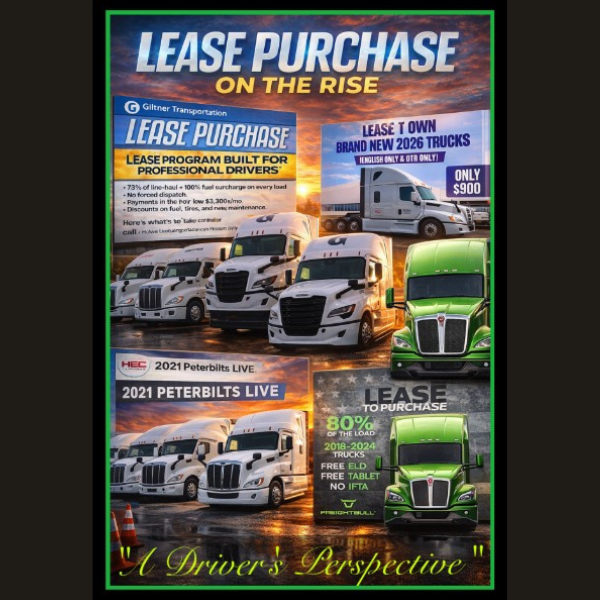
LEASE-PURCHASE ON THE RISE

Lease-Purchase-On-The-Rise-Image

A Full Look at What’s Happening

From A Driver’s Perspective

Lately, a lot of folks have been using lease-purchase as content – clips, reels, arguments, hot takes.  Some of it’s informed.  Some of it’s emotional.  Some of it’s just engagement farming.

Here at A Driver’s Perspective, this isn’t about building a platform or selling a position.  It’s about laying things out plainly – from experience, observation, and time in the seat – and letting drivers think for themselves.

We’re seeing a wave of lease-purchase ads right now, and it’s consistent with what the market is doing heading into early 2026: capacity is finally tightening after a long downcycle, and carriers are repositioning to capture upside – without taking all the risk themselves.

Here’s what’s driving the comeback (as of late January 2026), and what it’s really saying about the industry.

1) The freight cycle is turning – capacity is tighter than it’s been in years

Multiple market updates in January show higher tender rejection rates and more leverage shifting back toward carriers compared to 2023-2025.  FreightWaves noted January tender rejections near ~10% – a level above anything seen in the last two years and only comparable to the 2022 comedown period.  Other 2026 outlooks also point to tightening capacity as a key reason rates may rise this year.

Translation: when dispatch boards get hotter, carriers want more trucks committed to their network.  Lease-purchase is one way to lock in trucks and drivers.

2) Lease-purchase lets carriers grow capacity without buying it – and shifts risk onto the driver

When a carrier runs a lease-purchase fleet, they can often:

  • Fill seats and trucks faster (a strong recruiting tool when company-driver hiring tightens)
  • Stabilize capacity (lease drivers are motivated to keep rolling to cover the note)
  • Reduce their own exposure to maintenance spikes, downtime, weak weeks, and turnover

In plain English: lease-purchase can become a risk-transfer model disguised as “be your own boss,” especially when freight is volatile.

3) Used truck activity is moving again – carriers want to monetize equipment

Used truck volumes and pricing picked up going into year-end 2025 and early 2026. ACT noted Class 8 retail prices rose in December, and industry coverage highlighted increased auction and retail movement.

That environment makes lease-purchase more attractive to carriers because trucks are:

  • Easier to place into programs
  • Easier to value
  • And sometimes easier to move off the balance sheet

4) Regulatory pressure is rising on lease-purchase fine print

FMCSA’s Truck Leasing Task Force has raised concerns that lease-purchase rules “lack robustness,” and recent CFPB-to-DOT discussions include reviewing lease terms that may be unfair to drivers.  In practice, drivers often rely on Truth-in-Leasing protections under 49 CFR Part 376.

What this means in real life: some carriers may be pushing lease-purchase harder while also rewriting contracts to look cleaner and reduce regulatory exposure.

5) Another tailwind: enforcement and policy actions that could remove capacity

There’s renewed discussion around enforcement and eligibility issues that could pull capacity out of the market and support rates.  Carriers anticipating tighter capacity have extra incentive to secure trucks and drivers through long-term arrangements, like leases, so they’re not scrambling later.

What this trend is really saying about the industry

When lease-purchase starts showing up everywhere, it usually signals two things at once:

  1. Carriers believe the next 6–18 months may pay better than the last couple of years—they want trucks positioned now.
  2. They still don’t want all the downside risk—repairs, downtime, weak weeks, and fuel swings. Lease-purchase lets them chase upside while shifting downside to the driver.

That’s not automatically “bad.”  It’s just the business logic.

How to read the ad being pushed (the subtext)

Claims like:

  • “73% of linehaul + 100% fuel surcharge”
  • “No forced dispatch”
  • “Payments in the low $3,300s per month”
  • “Discounts on fuel, tires, and maintenance”

…are designed to hit the two biggest emotions in this market: control and survival.

But the real question is simple: What happens on a bad week?

Breakdowns.  Freight dips.  Weather shutdowns.  Low miles.  Trailer shortages.  Bad dispatch. Deadhead.  Reset weeks.

That’s where lease-purchase programs are either exposed – or proven fair.

From A Driver’s Perspective:

12 questions that expose the truth fast

If a company can answer these clearly, in writing, you’re dealing with a more serious program:

  1. What are average weekly miles for lease operators by lane or region – not best-case?
  2. What is the all-in weekly fixed net (truck payment, insurance, plates, ELD, permits, escrow – everything)?
  3. Who controls fuel surcharge math – do you receive 100% exactly as billed?
  4. What chargebacks will you see (tires, DEF, tolls, lumpers, trailer rental, reefer fuel, admin fees)?
  5. Maintenance: how much is escrow, when can you access it, and do you lose it if you exit?
  6. Breakdown policy: loaner truck or unpaid downtime?
  7. Settlement transparency: can you see rate confirmations and customer linehaul vs accessorials?
  8. “No forced dispatch”: can you refuse loads without punishment or retaliation?
  9. Early termination: what are the walkaway costs, and can they bill you after turn-in?
  10. What’s the balloon or buyout at the end?
  11. What warranty coverage exists – and what voids it?
  12. Can you speak with three current lease drivers, not recruiter-selected success stories?

If they dodge these questions, the program is usually built to win for them, not for you.

WHEN LEASE-PURCHASE ACTUALLY MAKES SENSE (and when it doesn’t)

Lease-purchase isn’t automatically good or bad.  It’s a tool.

And like any tool, it can either build something – or take a finger off if you use it wrong.

The problem isn’t that lease-purchase exists. The problem is that many drivers are pushed into it at the wrong time, under the wrong conditions, with the wrong expectations.

When lease-purchase can make sense

Lease-purchase can work only if most of the following are true:

  • You already know your numbers – fixed costs, cost per mile, break-even RPM
  • You’re entering at the right point in the freight cycle
  • The carrier’s freight fits your operating style
  • You have a real financial buffer, not hope

Lease-purchase should be a strategic move, not an escape hatch.

When lease-purchase is a bad idea – full stop

  • If it’s sold as a rescue plan
  • If the contract punishes you for slowing down
  • If transparency stops at the settlement
  • If success stories are curated

In those cases, it’s not independence – it’s exposure.

LEASE-PURCHASE vs TRUE OWNERSHIP vs COMPANY DRIVER

Which one fits which driver?

Each model fits a different driver, in a different season, with different priorities.

Company Driver

Best for stability.  Not weakness.

Lower upside.  Lower risk.  Higher floor.

Lease-Purchase

Best for transition.  Not escape.

More control.  More pressure.  Limited leverage.

True Ownership

Best for business-minded operators.

Maximum upside.  Maximum responsibility.  No safety net.

The real problem isn’t the model  It’s the narrative

Drivers are constantly told:

  • Company driver = stuck
  • Lease-purchase = freedom
  • Ownership = success

That narrative serves recruiting – not drivers.

Real success is alignment:

Your finances.  Your stress tolerance.  Your family.  Your season of life.

The question every driver should ask

Not:

“Which one makes the most money?”

But:

“Which one lets me survive bad weeks without losing control?”

Because trucking doesn’t break drivers on good weeks.  It breaks them on the bad ones.

Final word from A Driver’s Perspective

There is no shame in choosing stability.  No badge for suffering.

And no shortcut to independence.

The smartest drivers aren’t chasing titles.  They’re choosing positions.

— Will

Just A Driver’s Perspective
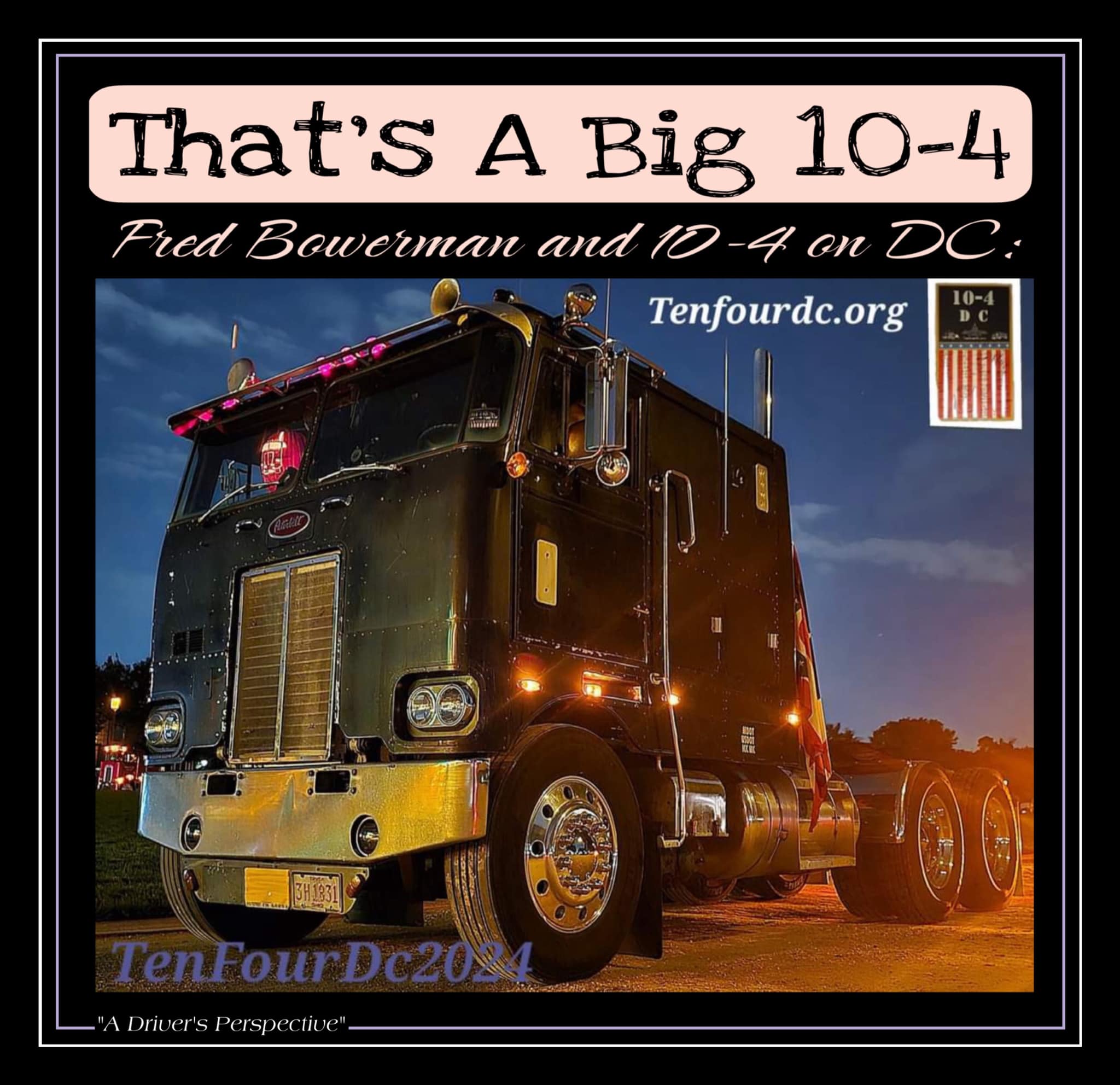
That’s a Big 10-4 on D.C.

The Story Behind 10-4 on DC – and the Man Who Helped Keep the Message Alive

A Legacy Born from Loss

Fred Bowerman’s connection to trucking runs deeper than chrome, diesel, and long miles – it’s born from tragedy, resilience, and a lifelong respect for the men and women behind the wheel.

At just five years old, Fred lost his father – an owner-operator – in a fatal crash near Fremont, Indiana.  His dad had just finished prepping a new Peterbilt cabover and was on his first run when he fell asleep, swerved to avoid stopped traffic, and struck an overpass support.  The accident crushed the cab and ended his life instantly.

Despite the loss, trucks remained a part of Fred’s world.  His mother later married another truck driver, and memories of that old ’73 Peterbilt in the driveway kept his fascination alive.

A Dream Redirected

After high school, Fred hoped to follow in his father’s footsteps – but his battle with sleep apnea changed his path.  On his mother’s urging, he stayed off the road and pursued a career in mechanics, earning a journeyman’s card and later moving into robotics and engineering at the Toledo Jeep plant.

Still, he couldn’t stay away from trucks entirely.  At 21, he bought a 1988 Ford CLT 9000 cabover using his inheritance and hired a driver while keeping his factory job.  Three years and $5,000 in losses later, he sold the truck and stepped away – but the passion never left.

The Return of the Cabover – and a New Calling

In 2017, Fred bought a 1978 Peterbilt 352 cabover similar to his father’s.  It wasn’t about business anymore – just love for the machine and the memory it carried.  That same year, his life took another turn when he joined a D.C. protest against the federal Electronic Logging Device (ELD) mandate.

What started as frustration over government overreach became something bigger.  A convoy of truckers rolled into Washington, parking outside the FMCSA building in protest. Their timing was divine – the meeting that followed took place on October 4, known to drivers by the CB code “10-4,” meaning message received.

The meeting led to real results, including flexible sleeper-berth provisions – proof that when drivers stand together, Washington listens. And just like that, the phrase 10-4 on D.C. was born.

From Protest to Platform

What began as a spontaneous protest grew into a yearly movement of unity and advocacy. Fred – who had initially joined to “fill a seat” – soon became one of its steady hands.

After a chaotic 2018 protest (where one organizer was tased by police during a permit dispute), Fred stepped in to help bring structure and professionalism.  With his engineering mindset, he helped secure proper permits, built the 10-4 on DC website, and turned the loose coalition into an organized event with purpose.

By October 2018, they held their first official event on the National Mall, honoring drivers and educating the public about the challenges of life on the road.  The following year, the movement doubled in size, featuring convoys, concerts, and listening sessions with federal officials.

Eight Years Later: The Message Still Carries

Now in its eighth year, 10-4 on DC has evolved far beyond its original fight.  It stands as a tribute to America’s truckers – a blend of remembrance, awareness, and pride.

Fred’s story reminds us that advocacy doesn’t always come from behind the wheel. Sometimes it comes from someone who understands what’s at stake, even if they never logged a mile.

“Drivers have so much strength if they would use it,” Fred says.  “We’re stronger together than divided.”

As automation rises, policies tighten, and the road gets lonelier, 10-4 on DC continues to symbolize what trucking has always been about – brotherhood, backbone, and the American spirit.

A Big 10-4

I never knew Fred’s story until we sat down and talked.  Like many, I’d always wondered why someone who never drove for a living would pour so much heart into the driver’s cause. Now I get it.

His father’s legacy may have ended on the highway that night in Indiana – but Fred’s work ensures that legacy still drives forward, every October, in the nation’s capital.

Thank you, Fred, for sharing your story and keeping the light burning for the men and women who keep America moving.

Editor’s Note:
While this story highlights Fred’s unique role and perspective, TenFourDC was never the work of one person alone. It was built through the shared efforts, ideas, and time of many who believed in creating something that connected drivers and supporters alike. Fred’s story simply stood out as one part of that bigger picture – alongside others like Miss Arlene Bennett, whose involvement showed how even those who don’t drive a truck still have an important place in the movement. That spirit of teamwork is what TenFourDC was founded on – and what continues to move it forward.

Will Cook

A Driver’s Perspective

[TenFourDC.org]

Charles Claburn Interview

GOOD MONDAY MORNING – Let’s kick off the week with a flashback from the past that still hits hard today.  The title alone says it all:

[ YOU CAN’T HANDLE THE TRUTH ]

I had the opportunity to sit down with a man who’s never been afraid to tell it like it is – Charles Claburn. For more than 20 years, Charles has been a relentless voice for truckers, speaking out about the hard truths most people don’t want to hear.

In this conversation, he opens up about unity, manipulation, and the ongoing fight to reclaim trucking from the inside out. It’s raw, it’s real, and it’s long overdue.

October 6, 2025

When I sat down with Charles Claburn, I wasn’t talking to a man who read about trucking from behind a desk or built a following by shouting on social media.  I was talking to a man who lived it – who fought the battle for drivers long before hashtags and livestreams ever existed.

He’s a name that carries weight among the ones who remember when drivers stood shoulder to shoulder, not screen to screen.

Charles has been speaking out for truckers for more than two decades. Not because he wanted to – but because other drivers, the ones who respected him, told him he needed to.

“I didn’t volunteer for it,” he told me.  “Older drivers pulled me aside and said, ‘Charlie, you’ve got a way with words, and you ain’t scared.  Go tell them what we’re dealing with.’  I told them I’d rather be hauling milk.  That’s how it started.”

The Early Fight

The story goes back to New York in the early 2000s. Fuel prices were choking the small carriers and independents. Nobody in Albany wanted to hear about it – until Charles and a handful of drivers made them.

“We didn’t have sponsors.  We didn’t have GoFundMe. We had CB radios, word of mouth, and conviction,” Charles said.  “When we told the state police we were coming, they said, ‘You’re not convoying into Albany.’  I told them, ‘You try to stop 200 trucks and you’ll have a bigger problem than a fuel protest.’  Guess what?  We rolled.”

When those rigs pulled into the capital, they didn’t come to make noise – they came to make a point.  A sitting governor walked down the steps to meet them face to face.

“We didn’t need a celebrity or a livestream,” Charles said.  “We needed a message, and we had it: stop killing the little guy.  That day proved that if you organize right and you speak with purpose, they will listen.  But you’ve got to mean what you say.”

Those early wins, he told me, weren’t about personality – they were about presence.  Real drivers.  Real sacrifice. Real unity.

The Albany Lesson

Charles explained what made those movements work – discipline, respect, and leadership that didn’t need a camera to validate it.

“We weren’t perfect,” he said, “but we had structure.  We didn’t call ourselves heroes.  We just did what had to be done.  Guys like me were still hauling loads in between calls.  We’d park, protest, and go right back to work. It wasn’t about ego.”

That mindset – humility in the fight – is what made the difference.  The press couldn’t twist it, and the public couldn’t deny it.

But Charles watched the industry change.  The unity that once made trucking powerful started to fracture under politics, personality, and pay-to-play leadership.

“You can’t build a movement on selfies,” he told me.  “Once they started chasing views instead of results, it stopped being about drivers.  It became about branding.”

The Modern Problem

When the People’s Convoy hit the headlines and social-media voices started claiming to represent “all truckers,” Charles saw a familiar pattern forming – the same manipulation he’d witnessed years before, now weaponized through algorithms.

“The problem isn’t that drivers don’t care,” he said.  “It’s that every time one of us stands up, someone with a microphone tries to tear us down – especially if they can’t control the message.  The system knows how to exploit that.”

We talked about the ATU livestream incident, where Charles was silenced mid-conversation for asking a fair question.

“I didn’t come to fight,” he said.  “I came to ask, ‘What’s your plan?’  And they muted me. That right there told me everything.  Real leaders don’t fear questions.  They fear exposure.”

He compared it to an old farming lesson:

“When you want to keep cattle from going through the gate, you hang a shiny broom across the opening.  They’ll stop every time. Social media works the same way – every week it’s a new broom.  New distraction.  New ego.  Meanwhile, the same people in D.C. are tightening the leash on our livelihood.”

The Truth They Don’t Teach

We dug into policy – because that’s where Charles and I both believe the real war is fought.

“Executive orders ain’t law,” Charles said flatly.  “They come and go like campaign slogans. Until Congress writes it, it’s nothing but smoke.  But drivers see a headline and think we won.  Nah.  We just bought time.”

He shook his head when we talked about the FMCSA and DOT.

“They don’t make policy,” he said.  “They enforce what Congress funds. You want to fix trucking? You fix the people writing the checks – not the ones stamping the forms.”

That kind of plain talk is rare today. Too many influencers push narratives that sound patriotic but ignore how the system actually works.

“Most of these folks don’t want you educated,” he said.  “They want you emotional. Because when you understand who signs the bills – when you realize Congress controls labor, visas, pay, and automation funding – the whole game changes.  That’s why they keep us divided.”

What Drivers Really Need

Charles and I found ourselves circling the same three words: classification, pay, and training.

“Drivers need to be recognized as skilled labor,” he said.  “This isn’t fast food. It’s 80,000 pounds moving at 70 miles an hour.  You want better safety?  Start by paying people what the job’s worth.  Start by training them like professionals, not filling seats for bonuses.”

He pointed out that technology has become a crutch – and an excuse.

“Every sensor, every camera, every ‘safety feature’ is another way to justify undertraining and underpaying.  The more they automate, the less they have to respect you.  But here’s the truth: no machine will ever replace the judgment of a driver who cares.”

The Need for a Driver Voting Bloc

We talked about the one solution that keeps surfacing: power in numbers.

“Until we start voting as a bloc,” Charles said, “we’re just noise.  I don’t mean unionizing under one flag.  I mean using our voice as a class – the working class.  The ones who actually keep the lights on.  We need drivers in every district calling their reps, asking the same three questions: Where do you stand on classification, pay, and training?”

He grinned when he mentioned Truck the Vote, the movement that never got the traction it deserved.

“That was the right idea,” he said.  “We just didn’t have the infrastructure.  The ATA’s got millions.  We’ve got miles.  But if we ever aim those miles in the same direction, Congress will have to listen.”

That’s where Charles still puts his hope – not in influencers, not in organizations, but in the people behind the wheel who refuse to be silenced.

Where We Go from Here

As the conversation wound down, I asked Charles what keeps him speaking out after twenty years. His answer was simple.

“Because nobody else will. And because I still believe this industry can be saved – if drivers stop following personalities and start following purpose.”

In a world full of noise, Charles is still that steady voice cutting through the static – the kind of man who doesn’t just remember what trucking was, but what it stood for.

And that, more than anything, is what A Driver’s Perspective stands for.

Will. — A Driver’s Perspective

INSIDE OOIDA: The People Fighting for Drivers

A Conversation with Doug Morris, Director of Safety, Security & State Affairs

I got the opportunity to sit down with one of the many men and women who keep OOIDA going – just one of many important people who make this association what it is.  That’s the point of this new series: to give an inside look at the folks fighting for drivers and owner-operators inside OOIDA – what they do, how they do it, and why it matters.

For this first interview, I sat down with Doug Morris, OOIDA’s Director of Safety, Security & State Affairs. Before he became a voice for truckers in Washington, D.C., Morris spent more than 25 years with the Maryland State Police, leading transportation security after 9/11, working with federal and state agencies, and training in specialized commercial-vehicle inspections – including radiological, at a time when only a handful in the country had that expertise.  Since joining OOIDA in 2009, he’s become one of the industry’s most persistent watchdogs on safety regs, enforcement policy, and driver rights.

From Lawman to Driver Advocate
Morris didn’t set out to work for OOIDA. A trip to Kansas City to meet the team – and a dinner with the late Jim Johnston – changed his mind.

“When you see someone’s passion for trucking and for drivers, you want to be part of that,” Morris told me.

He took early retirement, joined OOIDA, and his role quickly expanded: national security initiatives, regulatory analysis, then lobbying, plus a heavy load of state-level legislative work during the first half of each year.

Who Writes the Rules (and Who Enforces Them)
One point Morris wants drivers to understand: Congress writes the laws; FMCSA implements what Congress funds; CVSA (a coalition of state enforcement) standardizes the inspection process and out-of-service criteria that states adopt and enforce.

“If you’re mad at FMCSA for something Congress mandated – or for how states are enforcing -it’s easy to yell at the wrong building,” he said.  “Know which committee holds the pen.”

The Non-Domiciled CDL Mess
On the hottest issue right now – non-domiciled CDLs and visa drivers – Morris is blunt.  The original intent of non-domiciled CDLs was simple: when a U.S. trainee tested in a different state than their residence, they’d transfer the temporary credential back home for a standard CDL.  It wasn’t meant as a backdoor for foreign drivers.

OOIDA, he says, had raised alarms for years, but national traction followed public attention and grassroots pressure after a series of fatal crashes and fraud cases made headlines.

  • OOIDA pressed FMCSA to restore English-language proficiency with real teeth in out-of-service criteria.
  • They engaged DHS and the DOT Secretary to tighten guidance and close loopholes.
  • They continue pushing states that still don’t track or properly gate non-domiciled issuances.

“It’s complicated for agencies that don’t live in this space,” Morris said. “You literally have to walk them through how CDL issuance works and where the guidance went sideways.”

Speed Limiters, ELDs, and Regulation by Megacarrier
Morris argues that some high-dollar lobbying campaigns push rules that benefit large fleets more than safety.

  • Speed limiters: “Great for fuel budgets, not a magic wand for crashes,” he said, noting increased rear-end collisions.
  • ELDs: Sold as a silver bullet, but in practice they’ve increased stress and congestion and boxed experienced drivers into unsafe timing.

“Talk to working drivers before you regulate drivers,” he said. OOIDA’s 21-member board—all truckers with hundreds of cumulative years behind the wheel—is built for that.

Money, Access, and the Grind
OOIDA’s lobbying dollars are modest compared to the millions spent by major trade groups and allied interests.

“Every dollar has to work,” Morris said.

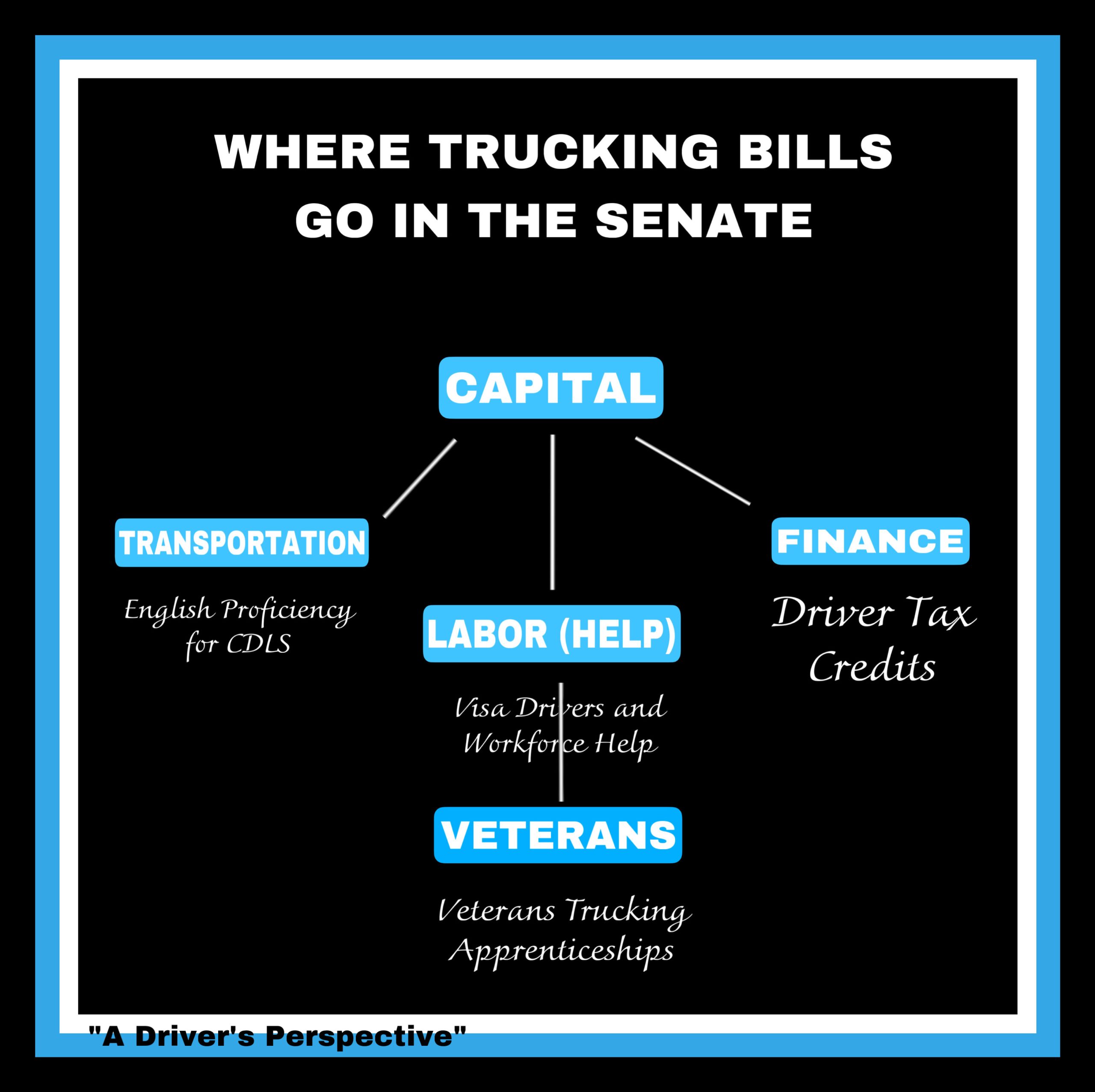
The counterweight is grassroots: members calling and visiting lawmakers, especially those sitting on Transportation & Infrastructure (House) and Commerce, Science & Transportation (Senate).

“Lawmakers listen to constituents – and to money,” Morris said.  “We need members engaged so our side of the story is in the room.”

Parking, Pay, and Predatory Leases
Beyond the headline fights, Morris points to other critical issues:

  • Guaranteed overtime for drivers – to push rates up and pay drivers for their time.
  • Free truck parking – while some paid-parking interests fight to preserve scarcity.
  • Predatory lease-purchase contracts – OOIDA’s Business Services reviews agreements and warns drivers when the math sinks them from day one.

On AB5/independent contractor rules, Morris deferred details to OOIDA’s legal team, but confirmed the fight is active and crucial to the owner-operator model.

Automation: The Existential Question
Morris’s starkest warning is about driverless trucks.  If Congress authorizes interstate operation without a driver in the cab, he believes small-business trucking will be gutted.  Billions in hedge funds and tech money are pushing hard; some states already allow AV pilots; federal preemption could accelerate it.

“There will be niches,” he said, “but for dry van, reefer, and flatbed – if we don’t act now – the handwriting is on the wall.”

What Drivers Can Do Right Now
Morris’s call to action is simple:

  1. Visit fightingfortruckers.com.
  2. Identify your House and Senate members.
  3. Meet staffers who cover transportation.
  4. Speak to specific bills – support or oppose – and explain the impact on your business.
  5. Build a relationship and follow up.

“Don’t waste your time shouting at the wind,” he said.  “Show up where decisions are made.”

Why This Series Matters
OOIDA is not just a logo – it’s hundreds of people grinding in meetings, drafting testimony, managing state fights, and walking the halls of Congress so drivers still have a future in this industry.  Doug Morris is one of them.

In the coming pieces, we’ll keep pulling the curtain back on the men and women inside OOIDA who spend their days fighting for drivers and owner-operators.

If you’re a driver or owner-operator, your voice matters.  Get informed, plug in, and stand with the folks who show up for you every day.

Will Cook | A Driver’s Perspective


[FightingForTruckers.Com]